Someone on the file asks the obvious question just before a client contract goes out for translation: “Do we have a data processing agreement with them?” There’s a pause. Nobody’s entirely sure, and the contract gets sent anyway, because the deadline doesn’t wait for a paperwork gap to get resolved.
That pause is the moment we’d stop and check, not push through. A translator handling a contract with names, addresses, financial terms and signatures in it isn’t a supplier in the ordinary sense — under GDPR, they’re a data processor, and that comes with obligations that “we’ve used them before” doesn’t satisfy. We’re Business Translations UK and this is what we’d actually check before the next file goes out.
A translation provider handling a contract with personal data in it must have a signed Data Processing Agreement with your firm under GDPR Article 28, covering security measures, sub-processors, retention and deletion. If your provider can’t produce one, or if the document is going to a translator based outside the UK or EEA without safeguards in place, that’s a compliance gap worth closing before the file leaves your building.
📌 KEY TAKEAWAYS:
- A translator working on a contract with personal data is a data processor under GDPR, not just a vendor.
- A confidentiality clause and a Data Processing Agreement are not the same document, and firms often assume one covers the other.
- Where the translator is physically based matters. Outside the UK or EEA without safeguards, it becomes an international transfer question.
- Free or consumer-grade translation tools are the highest-risk route for anything containing personal data, because they typically carry none of this.
Is Your Translator A Data Processor, Or Just A Supplier?
This distinction decides everything that follows, and it’s simpler than it sounds. If a translator only ever sees a blank template or anonymised text, they’re not processing personal data and Article 28 doesn’t bite in the same way. The moment they’re working on an actual client contract — names, addresses, dates of birth, financial figures, signatures — they’re processing personal data on your firm’s instructions, which makes your firm the controller and them the processor.
That’s not a technicality. It changes what you’re required to have in place before the file goes anywhere near them.
What A Compliant Data Processing Agreement Actually Covers
| Requirement | What it actually means | Red flag if missing |
|---|---|---|
| Written contract | A DPA specifically, not just general terms of service | Provider only offers a standard NDA |
| Documented instructions | Processor only acts on your firm’s written instructions | Vague “we’ll use our judgement” language |
| Confidentiality | Everyone touching the file is under a binding confidentiality obligation | No mention of translator or reviewer confidentiality specifically |
| Security measures | Technical and organisational measures matched to the sensitivity of the data | No detail beyond “we take security seriously” |
| Sub-processor control | Prior written authorisation before engaging another translator or reviewer | Provider can’t say who else might touch your file |
| Deletion and retention | Clear timeline for when files are deleted after the job closes | No answer, or “we keep everything indefinitely” |
The Five Questions Worth Asking, And The Answer That Should Worry You
1. “Can you send us a signed DPA, not just an NDA?”
🚩 Red flag: “We don’t usually do those, but we’re happy to sign whatever you send.” That means it doesn’t exist yet, and you’re the one building it from scratch under deadline pressure.
2. “Where is the translator physically based?”
🚩 Red flag: “We’re not sure, we source from a global pool.” If nobody can tell you the country, nobody can tell you whether an international transfer safeguard is even needed.
3. “Who else sees this file before it comes back to us?”
🚩 Red flag: A vague answer about “our network” rather than a named project manager, translator and reviewer. Sub-processors without prior authorisation are a direct Article 28 breach, not a grey area.
4. “What happens to our file once the job’s delivered?”
🚩 Red flag: “We keep it on our system in case you need it again.” Convenient for them, but retention without a defined policy is exactly what a firm gets asked to explain during an audit.
5. “What’s your process if something goes wrong on your end?”
🚩 Red flag: No clear answer on notification timelines. A processor who can’t tell you how fast they’d flag a breach hasn’t thought about it, which tells you plenty.
🔍 DUE DILIGENCE TIP: Ask these five questions before the relationship starts, not after the first contract’s already gone out. A provider who answers cleanly and specifically, rather than reassuringly, is the one worth using again.
Why A “Confidential And Secure” Translation Tool Isn’T Automatically Compliant
Plenty of translation tools market themselves as confidential, and plenty genuinely are careful with files. That’s a different claim from being GDPR compliant, and the gap matters most with free or consumer-grade tools. These typically lack a signed Article 28 contract altogether, which means a firm using one for a client contract carries the regulatory exposure directly and alone, with no processor obligations sitting alongside it. “Confidential” describes intent. A DPA is the legal instrument that makes it enforceable.
The International Transfer Question Most Firms Skip
Here’s the one we see missed most often, even by firms who’ve got the DPA sorted. GDPR restricts moving personal data outside the UK or EEA unless adequate safeguards are in place, and translation is an easy place for this to happen invisibly. An agency headquartered in London can still route a specific job to a freelance translator working from outside the UK or EEA, and unless you’ve asked, you won’t know it happened.
This doesn’t mean overseas translators are off the table. It means the transfer needs a proper legal basis, such as Standard Contractual Clauses, sitting behind it. Ask your provider directly whether any part of your file’s journey crosses that line, and what covers it if so.
How We’D Run This Check Before Signing Anything
Step 1 ➔ Confirm the classification.
Establish whether the document actually contains personal data, since not every business document does.
Step 2 ➔ Request the DPA before the first file, not after.
Waiting until a job’s already underway removes your leverage to ask for changes.
Step 3 ➔ Ask where the work will physically be done.
Get a country, not a general assurance.
Step 4 ➔ Check the sub-processor list.
Confirm you’d be told before anyone new joins the chain on your files.
Step 5 ➔ Confirm retention and deletion in writing.
Verbal assurances don’t hold up when a client or the ICO asks for evidence later.
Your Provider Verification Checklist
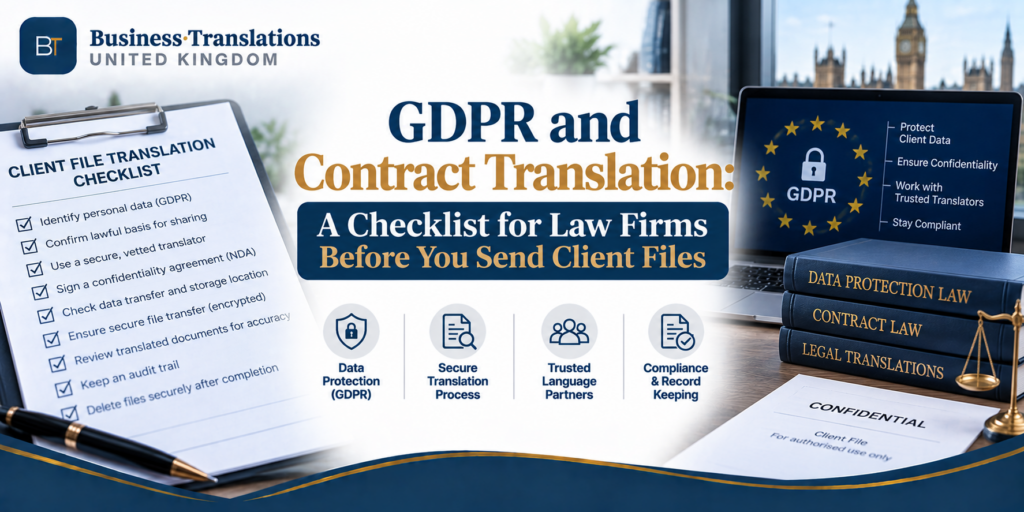
- Signed DPA in place, separate from any confidentiality agreement
- Confirmed country where translation work is actually carried out
- Sub-processor authorisation process understood and agreed
- Retention and deletion timeline confirmed in writing
- Breach notification process and timeline confirmed
- No part of the file handled by free or consumer-grade translation tools
Frequently Asked Questions
Does Using A Uk-Based Translation Agency Avoid The International Transfer Issue Entirely?
Not automatically. A UK-headquartered agency can still route individual jobs to freelance translators working outside the UK or EEA, so the agency’s registered address doesn’t tell you where your specific file was actually processed. Ask directly rather than assuming location from the company address.
Isn’T A Confidentiality Clause With Our Translator The Same Protection As A Dpa?
No, and this is one of the most common assumptions we come across. A confidentiality clause stops information being shared with third parties; it doesn’t cover the specific processor obligations Article 28 requires, such as sub-processor authorisation, security measures, or deletion timelines. Firms often have one and assume it covers the other.
If Our Translation Provider Has A Data Breach, Who’S Liable — Us Or Them?
Both can carry liability, but as the controller, your firm typically remains responsible for the overall compliance of the processing, including choosing a processor who provides sufficient guarantees in the first place. A properly drafted DPA sets out the processor’s specific obligations, but it doesn’t remove your firm’s own accountability for having done due diligence beforehand.
Do We Need A Separate Dpa For Every Translation Job, Or Does One Agreement Cover An Ongoing Relationship?
One well-drafted DPA can cover an ongoing relationship, provided it’s written broadly enough to describe the nature and categories of processing rather than one specific job. What matters is that it’s actually in place and current, not whether it’s renewed per file.
Does Any Of This Apply To Interpreters As Well As Document Translators?
Yes, where an interpreter is handling a meeting or call involving personal data, the same processor logic applies, even though nothing’s being stored in the same way a document translation is. Ask the same questions about confidentiality obligations and data handling regardless of whether the work is spoken or written.
Conclusion
None of this assumes your current provider is doing something wrong. It’s about being able to prove it if a client or the ICO ever asks, rather than discovering the gap at the worst possible moment.
If you’re not certain your current provider could answer those five questions cleanly, or you’re setting up a new translation relationship for client contract work, we’re happy to walk you through exactly what our specialists have in place — DPA, sub-processor list, retention policy and all — before your next file goes anywhere.